’Trial for Bigamy’ sketch up for auction again

November 21, 2025

A painted sketch – the back of the frame signed Ey. Crowe, December 14th-15th 1896 – is up for auction again just over a year after it was last sold. It would seem to be a painted sketch of the scene at Leeds Crown Court which was afterwards worked up into the finished oil painting Trial for Bigamy, exhibited at the Royal Academy in 1897. On the back is pasted a black and white photograph of the 1897 painting as published in ‘Royal Academy Pictures’.

Sold for £350 by Tennants of Leyburn last year, the painting is part of an auction at Mallams in Oxford on 10 December, with a guide price of £300 to £500.

Painting for sale through Tennants auctioneers, 2024

Reverse side of painting for sale through Tennants auctioneers, 2024


A Lumber Yard, attributed to Eyre Crowe, sold at auction

February 9, 2025
Landscape scene showing brick buildings, tall trees and stacks of cut timber

This painting, unsigned, but attributed to Eyre Crowe on the basis of a fabric label ‘Crowe, E., Esq., 22 Feb 1898’ on the canvas stretcher bar, was sold at auction in Bedford on 7 February 2025 for a hammer price of £150. It is in the style of Crowe’s later landscape paintings, but unusual in not including any figures. It was perhaps unfinished and this could explain the lack of signature. Read more about it on the page for A Lumber Yard.


Hauling the Boat Ashore (1871) – no! 1857!

November 22, 2024
‘Hauling the boat ashore – coast of France’ by Eyre Crowe (1857)

This exquisite painting first came to my attention in 2010 when its owners kindly let me know about it. It was thought to have been dated 1871, and this was the date that Atkins Auctions also gave it when it was put up for sale at their auction house in Devon in 2022.

However, it actually dates from around 15 years earlier. I have just discovered a reference to Eyre Crowe’s Hauling the Boat Ashore – Scene at Portel, Coast of France, dated 1857, in the Smithsonian American Art Museum’s Pre-1877 Art Exhibition Catalogue Index. The index entry reveals that the painting travelled to America, and was shown in New York as part of the American exhibition of British Art in the autumn of 1857. There is a very interesting article about the exhibition by Dennis T. Lanigan on the excellent The Victorian Web site.

For the full write-up of this painting, see my page Hauling the Boat Ashore (1857).


Bicentenary 8: Kensal Green Cemetery

October 3, 2024

It’s Eyre Crowe’s 200th birthday!

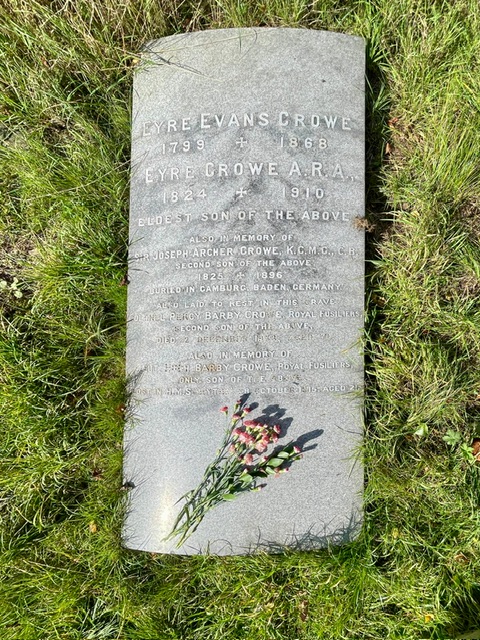
Eyre Crowe died at the age of 86 on 10 December 1910. He was buried in his father’s grave at Kensal Green Cemetery in West London. It’s a wonderful, green, leafy spot.

This is the final post in this series. Thank you for joining me on this trip through Eyre Crowe’s life.

Images: My own photographs of Eyre Crowe’s gravestone in Area 64 of the cemetery


Bicentenary 7: The Reform Club

October 3, 2024

It’s Eyre Crowe’s 200th birthday!

Eyre Crowe, like his father and his brother Joseph, was a member of the Reform Club, a private member’s club on Pall Mall in central London (now open to women as well as men!). He joined in 1861 and remained a member for the rest of his life. He was unmarried and lived and worked in small rooms and studios rather than having a house of his own. The Reform Club was a home from home, offering him comfortable surroundings, a well-stocked library, and good dining. He ate most of his evening meals at the Club with like-minded friends.

I have come to the Club today to meet the Archivist, Dr Peter Urbach, and to see a fine collection of Crowe’s pen and ink sketches of fellow club-members. They are regularly featured on the Club’s Instagram page https://www.instagram.com/reformclub

On Eyre Crowe’s 70th birthday, 3 October 1904, he wrote in his diary that he celebrated at the Reform Club with his friend Dixon. He enjoyed half a pint of marsala and three pennies worth of whiskey. Happy birthday Mr Crowe!


Bicentenary 6: Dr Johnson

October 3, 2024

It’s Eyre Crowe’s 200th birthday!

I have come to Dr Johnson’s House Museum in Gough Square, London, the home of Dr Samuel Johnson (1709-1794). Johnson was a writer and literary critic, and most famous for being the author of A Dictionary of the English Language (1755). It’s a lovely museum which gives a good idea of what London town houses were like in the 18th century – and you can find out how to make a dictionary!

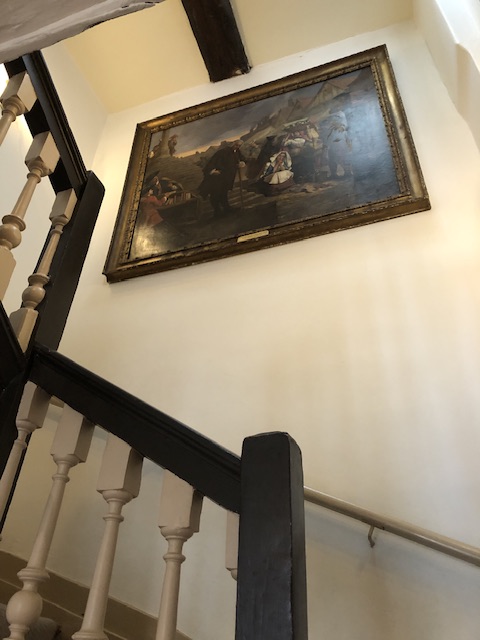
Eyre Crowe was a big fan of the giants of 18th-century British literature, and incidents in their lives were very popular subjects for artists of his time. Two of Crowe’s paintings featuring Dr Johnson are Boswell’s Introduction to the Literary Club (1856) and A Scene at the Mitre: Dr Johnson, Boswell, Goldsmith (1857). His third Johnson painting, The Penance of Dr Johnson, was exhibited at the Royal Academy in 1869 and is now owned by Dr Johnson’s House. It hangs in the Garret at the top of the staircase.

Image: Eyre Crowe, ‘The Penance of Dr Johnson’ (1869). Credit: Dr Johnson’s House Trust


Bicentenary 5: Thackeray

October 3, 2024

It’s Eyre Crowe’s 200th birthday!

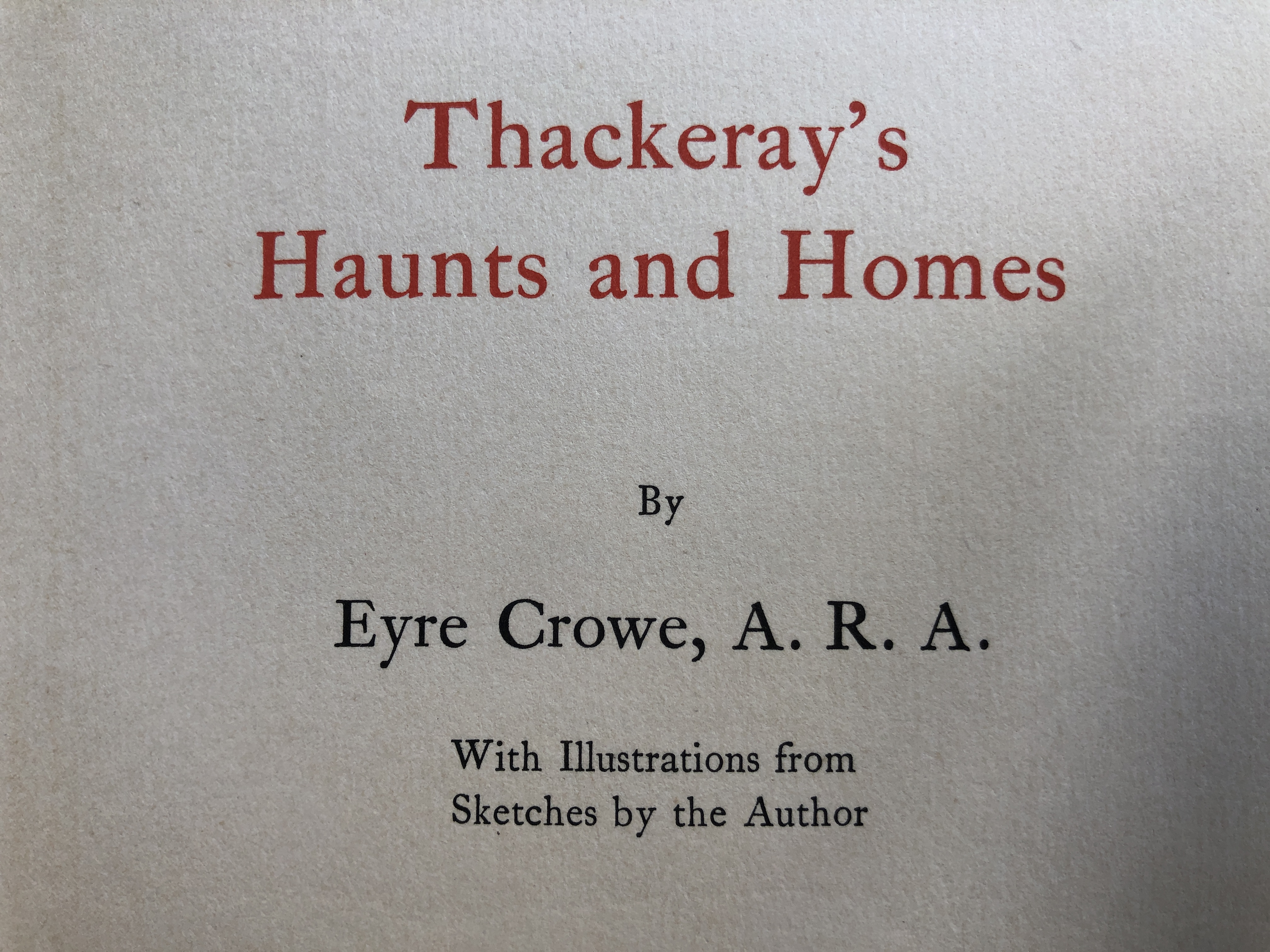
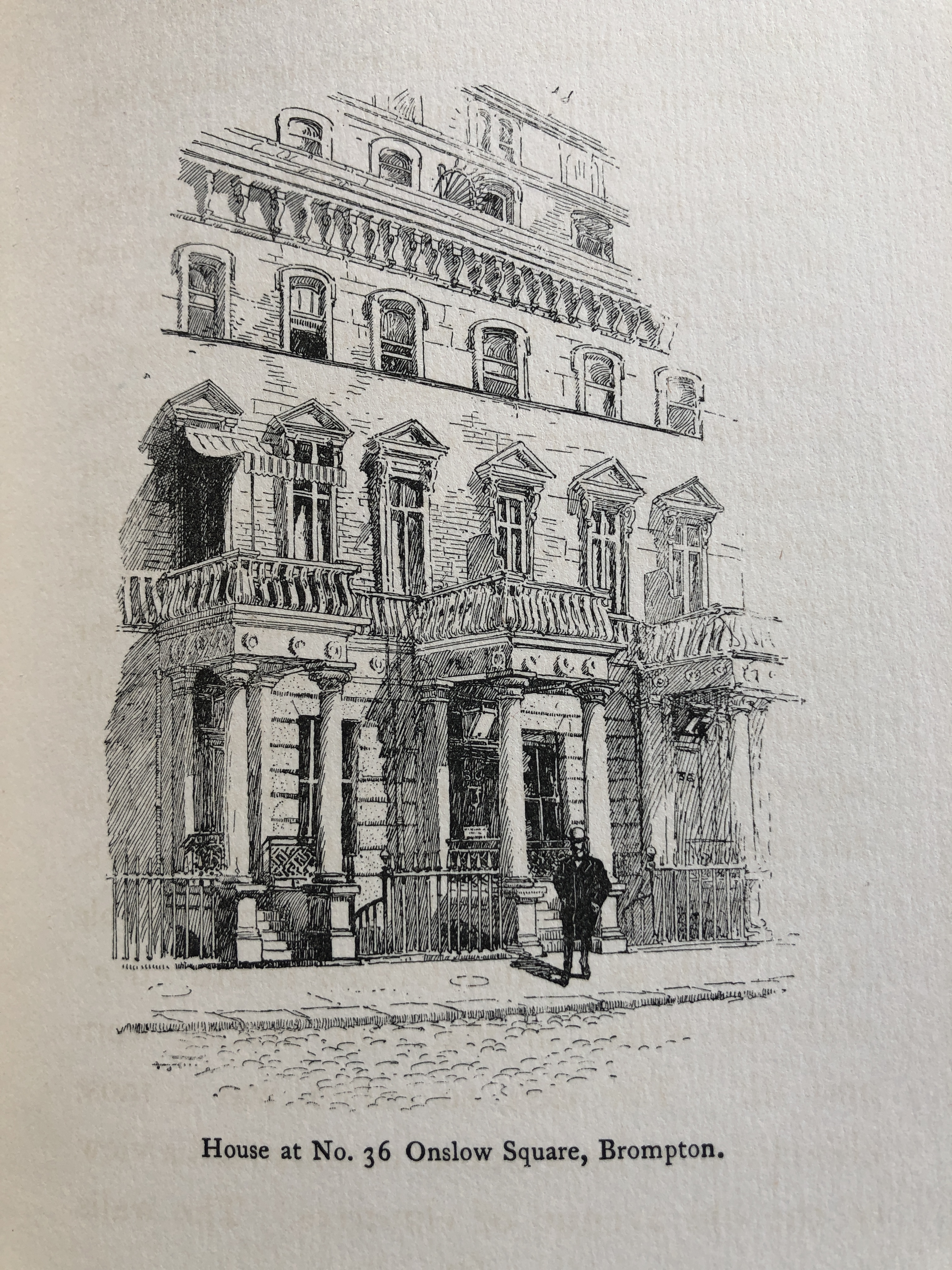
The writer William Makepeace Thackeray became friendly with the Crowe family in the 1830s in Paris. When Eyre Crowe was struggling to make money from art in the late 1840s and early 1850s Thackeray paid him to take dictation and engrave illustrations. In 1852-1853 Crowe accompanied Thackeray as his secretary on his lecture tour of America. In 1893 Crowe published his reminiscences of the trip in ‘With Thackeray in America’. Four years later, he published another book, ‘Thackeray’s Haunts and Homes’. In this book, he described how he heard of Thackeray’s early death in 1863. “on the day before Christmas came the announcement of his death, terrible in its suddenness to those, like myself, who had only his countless benefactions to dwell upon.”

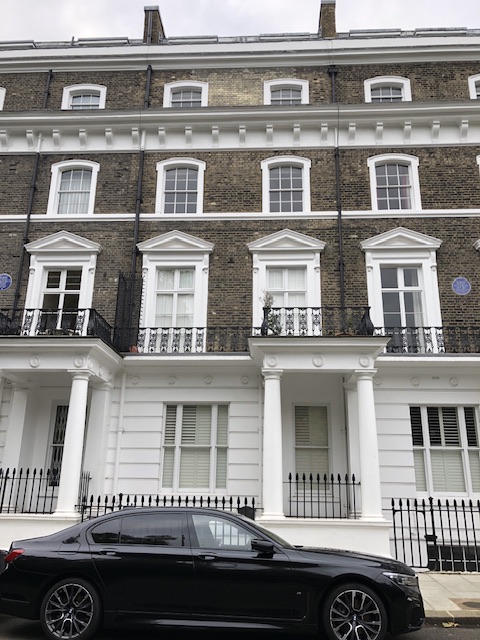
Images: Pages from Eyre Crowe, ‘Thackeray’s Haunts and Homes’ (1897), my own copy. Title page; facsimile of letter from Thackeray to Crowe, 1849; sketch of Thackeray’s house, 36 Onslow Square, in which Crowe’s sister Amy also lived in the 1850s, as a companion and governess to Thackeray’s two daughters. Photograph f 36 Onslow Square today, and Thackeray’s grave at Kensal Green cemetery.


Bicentenary 4: Royal Academy Exhibitions

October 3, 2024

It’s Eyre Crowe’s 200th birthday!

The pinnacle of the art season in London in the mid-19th century was the Royal Academy Summer Exhibition. Only members of the Academy had their paintings automatically accepted. Eyre Crowe had to compete with others until he was elected as an Associate in 1876. The first painting of his to grace the walls was ‘Master Prynne Searching Archbishop Laud’s Pockets in the Tower’ in 1846. Between 1857 and 1908, a remarkable 62 consecutive years, at least one Eyre Crowe painting was to be seen at the Royal Academy Summer Exhibition. Most were reviewed in the numerous newspapers and art periodicals which dedicated reams of copy to the exhibition in the 19th century. This website Eyre Crowe (1824-1910) contains information about all the paintings and transcripts of the reviews.

I have come today to the Royal Academy Archives, in their wonderfully atmospheric library, to see a series of master sales catalogues from the summer exhibitions, starting in 1861. I am hoping to find out more details about some of the paintings which were sold to new owners directly from the Royal Academy exhibition walls.


Bicentenary 3: Royal Academy of Arts

October 3, 2024

It’s Eyre Crowe’s 200th birthday!

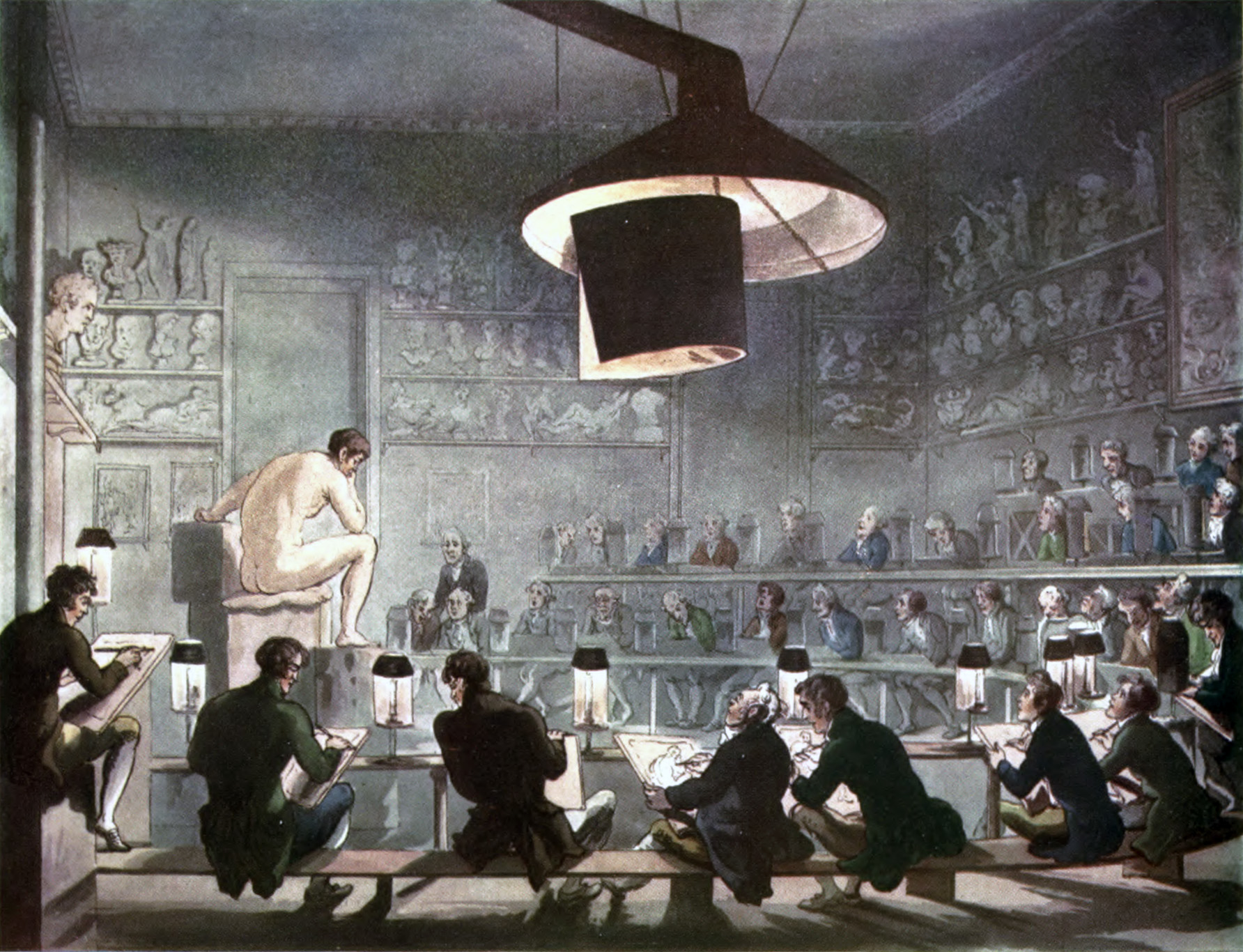
Eyre Crowe and his family moved back to London in 1844. He was 20 years old when he was accepted as a Probationer at the Royal Academy Schools on 11 July 1845. Dante Gabriel Rossetti joined on the same day. He became a full student on 19 December 1845. The initial part of the students’ training at this time was in the Antique School, making detailed hatched drawings of plaster casts and statues. They then progressed to the Life Academy and finally the School of Painting, and attended lectures. The Royal Academy of Arts was based in the National Gallery building on Trafalgar Square until 1869, when it moved to the current location at Burlington House, Piccadilly.

There is a digitised copy of the page showing Eyre Crowe’s entrance, from the Register of admission of probationers, 1824-1905. Royal Academy Collection, RAA/KEE/1/2.

Image: Drawing from Life at the Royal Academy (1808). Thomas Rowlandson (1756–1827) and Augustus Charles Pugin (1762–1832) (after) John Bluck (fl. 1791–1819), Joseph Constantine Stadler (fl. 1780–1812), Thomas Sutherland (1785–1838), J. Hill, and Harraden (aquatint engravers)


Bicentenary 2: Delaroche and Gérôme

October 3, 2024

It’s Eyre Crowe’s 200th birthday!

Paul Delaroche The Execution of Lady Jane Grey 1833 Oil on canvas, 246 × 297 cm Bequeathed by the Second Lord Cheylesmore, 1902 NG1909 https://www.nationalgallery.org.uk/paintings/NG1909

Eyre Crowe spent most of his childhood in Paris, where his father was working as a journalist. In 1839, at the age of around 14, he began studying art under Paul Delaroche (1797-1856), probably the most famous artist of historical subjects in France at the time. Delaroche’s influence on Crowe’s later paintings is clear. In 1843 Delaroche closed his studio and went to Rome. Crowe went there too, with his family for the winter, and was able to continue some studies with Delaroche. In Rome, Crowe became the firm and lifelong friend of the French artist Jean-Léon Gérôme (1824-1904).

Images:

Paul Delaroche, ‘The Execution of Lady Jane Grey’ (1833). The National Gallery, London. Licenced under Creative Commons licence CC BY-NC-ND 4.0

Jean-Léon Gérôme, by Ferdinand Mulnier, albumen carte-de-visite, late 1870s. National Portrait Gallery Photographs Collection NPG Ax17864. Licenced under Creative Commons licence CC-BY-NC-ND 3.0