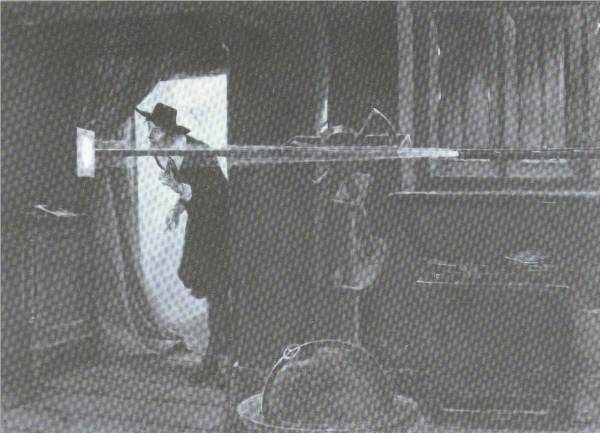
‘The Founder of English Astronomy’ by Eyre Crowe A.R.A. (1891). Reproduced in Royal Academy Pictures, 1891
Medium: oil
Size: 76.2 x100.3 cm
Exhibited: Royal Academy, 1891; Liverpool autumn exhibition, 1891; Liverpool Museums astronomy gallery, early 2000s
Current owner: Walker Art Gallery, Liverpool (WAG 1805)
Original caption: ‘Jeremiah Horrocks, curate at Hoole, Lancashire, having attended first to his religious duties on Sunday, November 24, 1639, and after having previously prepared his instrument for the observation of the transit of Venus, returns just in time to witness the event which he alone had correctly predicted as going to take place’
According to his diary, Crowe began work on this painting, then called ‘Horrocks seeing the actual transit of Venus’, in October 1889. He used a telescope set up by his friend from the Reform Club, the astronomer Sir Norman Lockyer, director of the Solar Physics Observatory at South Kensington. The painting depicts the Puritan clergyman Jeremiah Horrocks (1617-1641) observing Venus passing in front of the sun, using a projection onto a screen. Crowe is said to have visited Horrocks’ rented lodgings at Hoole in order to sketch the scene, and to have followed the description of the experiment given in a book by A.B. Whatton in an attempt to make the picture as authentic as possible. Despite these efforts, it is now known that the clothes and the instruments are both inaccurate.
The painting formed part of the Liverpool Autumn Exhibition of 1891, and was purchased and donated to the Walker Art Gallery by Charles William Jones in honour of the 21st anniversary of the autumn exhibition. It was on temporary display in the Liverpool Museum as part of its Astronomy exhibition in the early 2000s but is now in storage.
The painting is catalogued and reproduced in the volume Victorian and Edwardian Paintings in the National Museums and Galleries on Merseyside, Vol. 2 – ‘Victorian and Edwardian Paintings in the Walker Art Gallery and at Sudley House, by Edward Morris (Her Majesty’s Stationary Office, 1996).
Daily Telegraph, 11 May 1891
Mr. Eyre Crowe, A.R.A.’s (550), “The Founder of English Astronomy” is decidedly a very meritorious, but at the same time a somewhat “queer” picture. Mr. Eyre Crowe illustrates the circumstance that the Rev. Jeremiah Horrocks, coming home from church on Sunday, Nov. 1, 1639, having previously prepared his instruments for observing the transit of Venus, “returned just in time to witness the event which he alone had correctly predicted as about to take place.” A more out-of-the-way theme for a picture it would be difficult to imagine; but the artist has displayed considerable technical adroitness in giving plasticity, so to speak, to a scientific diagram. He has made the most of the reverent author of “Venus sub sole visa,” his optic glass and his refracting disc, and at all events has obtained, by means of the simulation of the solar ray, an almost Rembrandtesque effect of chiaroscuro. In an age mainly distinguished either by artistic timidity or by a seeming courage, which is often only so much blague and affection of, eccentricity, it is pleasant to meet with an honestly ambitious and boldly earnest work.
Athenaeum, 23 May 1891:
The small room is a true portrait of that still existing in Carr House, Hoole, and the rude transit instrument of the period is placed near the green curtain of the window, its uncouth and clumsy supports being conspicuous in the half gloom, and the sheet of paper is duly suspended to receive the luminous image, while athwart the scene pours that narrow ray of light which comprised the dark figure of Venus. The predicted hour fell on a Sunday, when Horrocks was bound to intermit his observations to do duty at the neighbouring church. As it happened, he was able to return home in the nick of time. Mr. Crowe has shown Horrocks entering the room. The action of the observer, the eager eyes and parted lips, his hand lifted in wonder, and his delighted expression, are capitally and sympathetically given.
The Leeds Mercury, 25 May 1891
The narrative pictures in this room [Gallery VI] – for it is scarcely possible to describe them as historical – include … Mr. Eyre Crowe’s somewhat grotesque tribute to “The Founder of English Astronomy” (550) – a title assigned to Mr. Jeremiah Horrocks, of Hoole, Lancashire, who had predicted and afterwards verified the transit of Venus on Nov. 24th. 1639.
Birmingham Daily Post, 13 June 1891
Mr. Eyre Crowe, A.R.A., depicts “The Founder of English Astronomy” (550), Jeremiah Horrocks, curate at Hoole, Lancashire, of whom it is told that, having attended first to his religious duties on Sunday, November 24, 1639, having previously prepared his instrument for the observation of the transit of Venus, her returned just in time to witness the event the exact moment of which he alone had been able to predict. It is the moment of return that Mr. Crowe has chosen, and he depicts vividly, and with evident sympathy, the eager delight and gratification of the man of science.
Liverpool Mercury, 28 September 1891
This year being the 21st anniversary of the Liverpool Autumn Exhibition, Mr. Charles W. Jones has purchased and presented to the permanent collection the appropriate picture of “The Founder of English Astronomy”, Jeremiah Horrocks, by Eyre Crowe A.R.A., as a (coming of age) gift.
 Eyre Crowe (1824-1910)