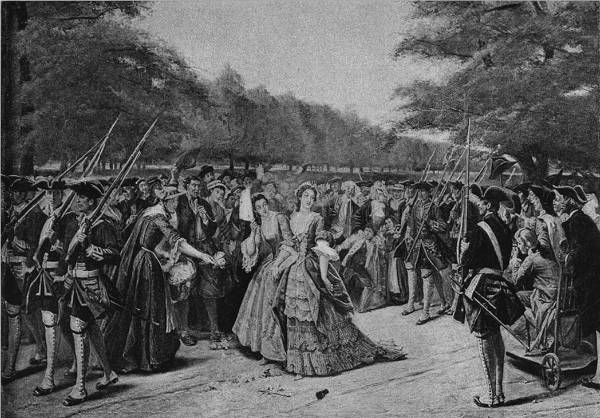
‘Lady Coventry’s Escort’ by Eyre Crowe A.R.A. (1892). Reproduction from Royal Academy Pictures, 1892, p. 61
Medium: oil
Size: 50 x 74 inches
Exhibited: Royal Academy, 1892; University of Minnesota, 1974 (sketches)
Current owner: Private collection / sketches in oil at Princeton University Art Museum
Original caption: ‘Lady Coventry, having been insulted in the park Sunday se’night, the King (George II) heard of it and said that to prevent the same for the future, she should have a guard, etc.’
The quotation accompanying the picture came from Horace Walpole’s Letters, and referred to the vain action of the celebrated beauty Lady Maria Coventry (1733-1760) in taking up King George II’s offer of an escort of two servants of the guard and 12 soldiers to accompany her on a walk through Hyde Park, after she had been mobbed the previous week by people eager to see her face.
Three small cabinet-sized sketches for the picture were sold at auction in 1972 and 1973 and purchased by the Forbes Magazine Collection. They featured in an exhibition at the Minnesota University Art Gallery, ‘The Art of Mind of Victorian England: Paintings from the Forbes Magazine Collection’ in 1974; and in the ‘The Royal Academy, 1837-(1901) Revisited’ exhibition at the Metropolitan Museum of New York in 1975. Black and white images of each of the three sketches, with details of the 1970s sales and exhibitions, are on the Paul Mellon Centre Photographic Archive catalogue. They were subsequently donated by the Forbes family to the Princeton University Art Museum and are listed on the Museum’s website.
The painting itself was part of the collection of Columbia College (now Loras College), Dubuque, Iowa, until 1977, and is now in a private collection.
The Scotsman, 7 May 1892:
Mr Eyre Crowe, the Associate… is responsible for a very bad picture, painted on a large scale, which he calls ‘Lady Coventry’s Escort’ (535). That is should have been hung on the line is not creditable to the Hanging Committee.
Daily Telegraph, 16 May 1892
… Lady Butler has unfortunately adopted a harsh and “ropy” style of treatment, the reverse of gratifying to the eye. She is as hard, indeed, as Mr. Eyre Crowe, A.R.A., which is saying a great deal. This erudite, experienced, and keenly perceptive artist sends (535) “Lady Coventry’s Escort,” an important and all but thoroughly well executed picture. He has gone to Horace Walpole’s “Letters” for the anecdote of Lady Coventry having been insulted in the Park, and of George II having detailed a detachment of the Foot Guards for her protection; so that upon this foundation her ladyship, accompanied by a female friend, ventured boldly again to promenade the Mall. Mr. Eyre Crowe has drawn up his Foot Guards, and made another portion march in front and behind the ladies, with irreproachable attention to military etiquette. His Grenadiers are pictorially as true to the reign of George II as the bearers of Brown Bess in Lady Butler’s “Forced March” are true to the reign of George III. Lady Coventry and her companions are both dressed in blue, and might, so far as the accuracy of their costume is concerned, from their toupees to their boots and their fans to their shoe-heels, have stepped from one of Hogarth’s canvases. There is no confusion in the composition; and the background of trees, quaintly clipped in eighteenth century fashion, adds considerably to the realism of the scene. The whole picture is, unhappily, marred by the unrelenting hardness of the execution and the total absence of transparency and luminosity in the colour.
Birmingham Daily Post, 18 May 1891
Mr. Eyre Crowe’s “Lady Coventry’s Escort” (536) might be exhibited as a dreadful example of what an Associate of the Royal Academy may fall to. It is a laborious work, crowded with figures, but the painting is coarse and the feeling inartistic.
The Times, 21 May 1892:
Mr Eyre Crowe [has] a picture (535) which the French would expressively describe as inqualifiable. By what fatality is is that certain painters, whose hand and eye are not what they were, still attack the most complicated and difficult subjects? A simple portrait, a simple landscape, from their brush might pass without offence; but they attempt a crowd, an elaborate piece of history, a picture with much action and movement in it, and they leave the critic and the public no option.
Saturday Review, 21 May 1892:
Even Mr. Eyre Crowe has learnt a modern “tip” for the tree-painting of “Lady Coventry’s Escort” (535)
Daily News, 6 June 1892:
Near a favourable example (No. 534) of the mannered prettiness of Mr. Saul, who certainly paints children rather as they ought to be than as they are, hangs Mr. Crowe’s “Lady Coventry’s Escort.” The one painter, if he is artificial, is so with charm and grace; the other’s artificiality is unadulterated. The guards have turned out to give the insulted lady a sort of police protection, and is in his handling of the theme, in his mixing of the reds and blues of uniform and costume, Mr. Crowe has shown the courage of his heroine, though he fails to reproduce her dignity.
 Eyre Crowe (1824-1910)