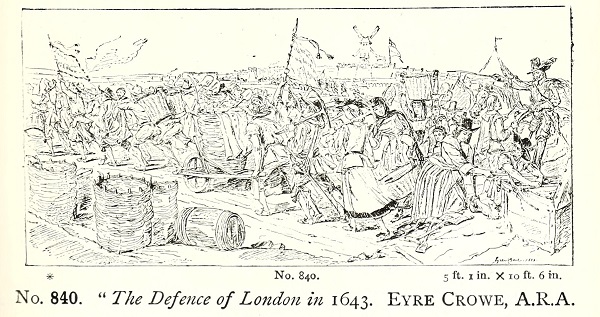
Pen and ink sketch version of ‘The Defence of London in 1643’, by Eyre Crowe, published in Henry Blackburn’s Academy Notes, No. 8, May 1882, p. 71
Medium: oil
Size: 61 x 126 inches (over 10 feet long!)
Exhibited: Royal Academy, 1882
Original caption: ‘Mount Hill Fort I found standing on a high way … the lower bulwarks are pallisaded round about. The figure on horseback is that of Major-General Philip Skippon, who commanded these Parliamentary forces, etc.’
A pen and ink sketch of the painting, by Eyre Crowe, was published in Henry Blackburn’s Academy Notes, No. 8, May 1882, p. 71
The Scotsman, 2 May 1882:
An incident of the defence of London in 1643 has been realised with notable force, if not without a strong dash of his peculiar mannerism, by Eyre Crowe.
Athenaeum, 6 May 1882:
Mr. Eyre Crowe has more than sustained the reputation acquired by his larger work of last year. He has sent to the Academy a long canvas, placed landscape-wise, and representing a procession of men and women carrying earth in gabions or entrenching tools. A more compact group are at work, or are looking on with animated interest. The picture is styled The Defence of London in 1643 (840), and it represents an incident of great historical importance which is described in the Somers Tracts, the narrative of William Lithgow. The figures move to our left and are directed by the drummer, and led by a standard-bearer, on whose black and yellow flag is written ‘St George’. At our right the Parliamentarian commander Skippon, a portrait, is discussing the plan of the circumvallation of London with a military engineer in a blue dress. A citizen’s wife is clad in sober grey, with the oak-leaf badge of her party in the stare; this decoration appears in the headgear of most of her neighbours. Among the crowd a stalwart, lean fellow trundles a laden barrow, on which is a gabion. In the mid-distance is Mount Mill Hill Fort, which stood at the upper end of Aldersgate Street, and is here set forth with its bastions and the flying standard of the popular party. The characters, attitudes, and expressions in this picture are varied, full of animation, and perfectly appropriate. The painting would be more agreeable than it is if the tones were more varied and the colour clearer as well as richer.
Aberdeen Weekly Journal, 10 May 1882
[In Gallery 8]… the “Defence of London, 1643,” by Eyre Crowe (840), an effective scene of some historical value.
Illustrated London News, 13 May 1882:
Mr. Eyre Crowe has lighted on a capital subject in ‘The Defence of London in 1643’ (840) by the Parliamentary forces; but what has happened to the painter that he should conceive our ancestors to have been such hideous, ill-made mannikins as he has depicted them, and that he should restrict his palette to hues so leaden, opaque, and inartistic?
The Times, 13 May 1882:
This is a large, long picture of a train of citizens of both sexes and all classes and occupations, hastening towards the fortifications, ‘carrying on their shoulders mattocks, spades and shovels, with roaring drums, flying colours, and girded swords’ … Mr. Eyre Crowe at no time surrenders over much to the seductions of beauty, but this work is marvellous in its straitened ugliness of colour and form, And there is a uniformity of expression in the people’s faces that tells us nothing of what they are thinking. If this ‘Defence of London’ were the greatest joke in the world, they could not take it more unemotionally. A certain ability of draughtsmanship we must recognise, and certain perseverance, and accuracy of evenly-distributed work, but beyond and above that we find little.
The Graphic, 27 May 1882
Mr. Eyre Crowe has lavished a vast amount of labour on his very large picture “The Defence of London in 1643” (840) without producing an adequate result. The figures want vitality, and the colour throughout the work is earthy and opaque.
Daily Telegraph, 8 June 1882
To (840) Mr. Eyre Crowe’s, A.R.A., “The Defence of London,” an episode of the civil wars, when the citizens of London, men, women and children, busily toiled at the erection of fortifications, it would be unjust to deny the credit of great earnestness and conscientiousness in design, and indefatigable painstaking in execution. Nor is the expression of many of the faces of the defenders of London destitute of ably-rendered suggestiveness of patriotic determination. The disappointing qualities of the work are apparent in its exceeding stiffness of contour, hardness of handling, and asperity of tone. It is true that Mr. Eyre Crowe might urge that, as the majority of the citizens of London, including the Corporation, were on the side of the Parliament in their struggle with Charles I, he has taken a Roundhead rather than a Cavalier view of the scene which he has portrayed. The chilly, ill-conditioned aspect of the shovel-and-pickaxe wielding concourse of people who are represented as labouring at earthworks and digging trenches round Mill-hill Fort might, indeed, almost favour the persuasion that the artist, before sitting down to work, had subscribed to the Solemn League and Covenant, and the Self-Denying Ordinance, forsworn maypoles, morris-dances, Whitsun ales and plum-porridge, and for mental edification, read, at least three times, from beginning to end, the celebrated tractate on “the Unloveliness of Lovelocks” and William Prynne’s “Histrio-mastix.”
Art Journal, August 1882:
The general composition is animated and bustling; but when we have said that, we have said all that we can in its praise. There is nothing which, by any stretch of courtesy, can be called colour; the drawing is careless and the modelling childish.
 Eyre Crowe (1824-1910)