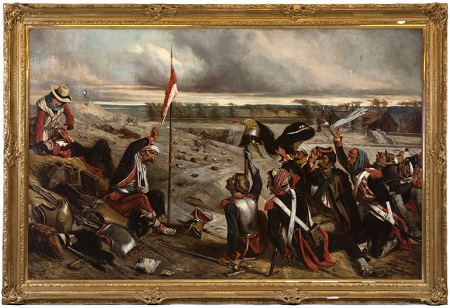
Hougoumont, the day after the battle (1886) by Eyre Crowe A.R.A.

Pen and ink sketch version of ‘Hougoumont’, by Eyre Crowe, was published in Henry Blackburn’s Academy Notes, No. 12, May 1886, p. 15
Medium: oil
Size: 52 x 80 inches
Exhibited: Royal Academy, 1886; St Jude’s, Whitechapel, 1887
Original caption: ‘Leaving Hougoumont, my attention was called to a group of wounded Frenchmen by the calm, dignified and soldier-like oration addressed by one of them to the rest. The speaker was sitting on the ground with his lance stuck upright beside him – a veteran lancer of the old guard, who had no doubt fought on many a field’.
A pen and ink sketch of the painting, by Eyre Crowe, was published in Henry Blackburn’s Academy Notes, No. 12, May 1886, p. 15
The painting was acquired by Steven J Harrison Antiques, Karlavägen 74, Stockholm, Sweden, in May 2010, and auctioned by Toovey’s of Washington, West Sussex, on 23 March 2011.
The Pall Mall Gazette, 1 May 1886:
“The Day after Hougoumont” (976) is sadly wooden, and is not worthy of Mr. Eyre Crowe.
The Graphic, 29 May 1886:
Mr. Eyre Crowe has a well composed group of wounded French soldiers, “Hougoumont,” overblack in the shadows and rather coarsely handled, but animated, and true in character.
Henry Blackburn, Academy Notes, No. 12, May 1886:
A group of wounded Frenchmen listening to an oration by one of them to the rest. The speaker, a veteran lancer of the old Guard, sits on the ground, with his lance stuck upright at his side.
The Leeds Mercury, 3 June 1886:
Mr. Eyre Crowe reverts once more to Waterloo, but instead of giving us the scene of troops locked in battle begrimed with smoke and fire, recalls Hougoumont (976) the day after the battle, with a group of French wounded prisoners accepting their fate with dignified sorrow.
Athenaeum, 12 June 1886:
In Gallery X the visitor will find Mr. Eyre Crowe’s Hougoumont, June 1815, the day after the Battle (976), wounded French soldiers of various corps cheering a sergeant who addresses them with an earnest air. All the faces are marked by spirit and energy, and full of natural dignity. The figures are ably, but not exhaustively drawn. The colour would bear clearing, and the composition needs a little massing.
Art Journal, August 1886:
… painted with all the accuracy of detail to be expected of a scholar and man of letters, and well composed, but disagreeably crude and heavy in colour.
 Eyre Crowe (1824-1910)