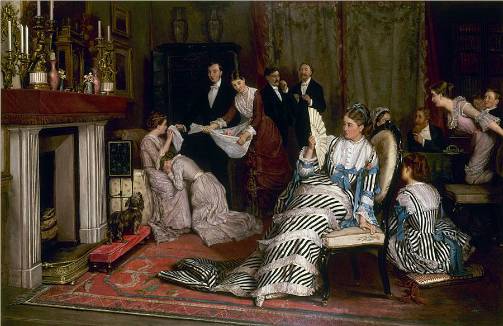
‘Forfeits’ by Eyre Crowe A.R.A. (1880)
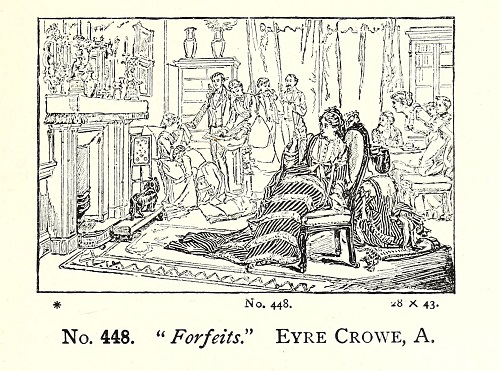
Pen and ink sketch version of ‘Forfeits’, by Eyre Crowe, published in Henry Blackburn’s Academy Notes, no. 6, May 1880, p.43
Medium: oil on canvas
Size: 29 x 44 ¼ in. (73.7 x 112.4 cm.)
Exhibited: Royal Academy, 1880
Pen and ink sketch, by Eyre Crowe, published in Henry Blackburn’s Academy Notes, no. 6, May 1880, p.43
This is probably the painting auctioned, as A Game of Forfeits, by King & Chasemore in Pulborough, England, on 10 October 1978 (lot 107). It was auctioned as part of the sale of Lord Astor of Hever’s property at Sotheby’s in London on 21 June 1983. The picture is reproduced in the exhibition catalogue. The anonymous purchaser in 1983 put it up for sale at Christie’s in New York (Lot 557) on 28 October 2019 with an estimate of $12,000-$18,000. It was described as the property of a ‘Southern seller’. The eventual hammer price reached was $10,000 (£7,776), with the buyer paying a total of $12,500 (£9,720) .
The Academy, 10 April 1880:
The two pictures which Mr. Eyre Crowe will exhibit at the Royal Academy show strongly contrasted subjects: one of them is a drawing-room scene, a game of forfeits; the other an interior in Westminster Abbey. It is some years since the artist has painted what is as frankly a Genre picture as this scene of modern life and gentle comedy. The reliance is placed, not so much upon beauty of colour – certainly not the strong point of the picture – as upon the story told and the piquant method of telling it. The figures are natural, and express gentle life in a way in which would have been difficult for them to do had they been painted from the paid model. One lady kneels, her face in the lap of another; one lady half hides her face behind her ample fan, for she it is who is destined to be kissed by the somewhat timid and irresolute young man now discreetly in the background. The quiet humour of the picture and its truth to every-day scenes are likely to commend it to the lovers of Genre painting, who are always numerous and influential. The picture should be engraved. In black and white it would be extremely telling.
Athenaeum, 1 May 1880:
Mr. Eyre Crowe contributes an animated and solidly painted picture called Forfeits (448), showing ladies and gentlemen amusing each other in a room. A group in front comprises a fair dame in the bloom of life, clad in a striped black-and-white dress; her attitude is very graceful and lifelike; behind her sits a younger damsel, wearing a similar dress. These figures are a little too sharply-defined, their dresses are slightly hard. There is much sound and good painting in the foreground accessories, although equal care has not been bestowed on those of the background and the smaller figures of an extremely happy design.
Daily News, 1 May 1880:
In the Fifth Gallery Mr. Eyre Crowe competes with Mr. Frith, and not unsuccessfully, in the elaborate “modernism” of “Forfeits” (448).
Daily Telegraph, 7 May 1880
(448) Mr. Eyre Crowe’s “Forfeits” is valuable for its minute fidelity as a transcript of feminine costumes at the present day. It is skilfully grouped, and full of patient finish.
The Pall Mall Gazette, 24 May 1880
Mr. Eyre Crowe has hardly made a success of his drawing-room picture – “Forfeits” – in which there is an attempt to tell the story of some serious relations between the actors underlying the mere game; but the painting seems on the whole rather too faithful an illustration of the fact that in modern society we have smoothed down great part of the interest of individual character, so far as it can be manifested in outward bearing, under the influence of conventional decorum and impassiveness. However, it is not easy to say how far the failure in this instance is in the subject or in the artist. Man even in a dress-coat has a good deal of human nature in him; and the drawing-room has a claim to a larger representation in the artistic treatment of contemporary life than it obtains. M. Tissot, who on his first residence among us took it up, had unfortunately with all his ability a twist in his artistic vision which only allowed him to see the inane type of drawing-room habitués, and from inanity he has lately fallen to sheer vulgarity in his figures of overdressed and simpering womankind. Mr. Eyre Crowe has qualities which might make him the painter of the drawing-room; but there is more to be done with it than he has yet done.
 Eyre Crowe (1824-1910)