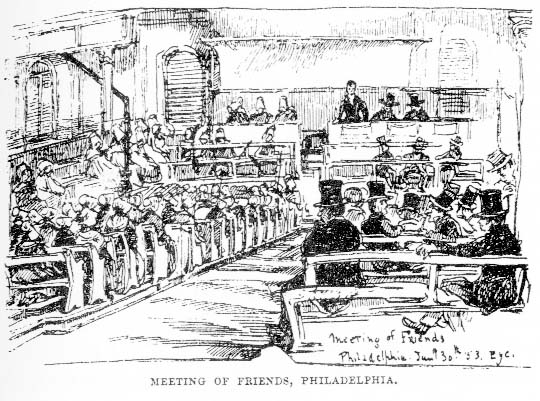
Sketch of Friends Meeting House by Eyre Crowe (1853), published in With Thackeray in America (1893)
Medium: oil
Exhibited: Royal Academy, 1871; Bristol Academy for the Promotion of Fine Arts 30th annual exhibition, 1875
Owner: In 1875, owned by Mr Kirkman Hodgson, M.P.
Friends was based on a sketch made by Eyre Crowe in Philadelphia in January 1853, when he was acting as William Makepeace Thackeray’s secretary in America.
The painting was singled out for praise by Crowe’s friend and fellow artist George Dunlop Leslie in his book The Inner Life of the Royal Academy (1914), p.196:
Crowe’s works possessed much of the sincerity and honesty that characterised the man himself; many of his earlier works being in this respect quite admirable. Such pictures as those he painted at the Blue Coat School and the Quaker’s Meeting, from the simplicity and truth with which the subjects are treated, have a charm about them that, as far as I know, is quite unique in pictures of this sort.
The Observer, 26 March 1871
[After mentioning a painting by Mr. Yeames]. We must not leave the St. John’s Wood district without stopping to admire a picture by Mr. Eyre Crowe, which will attract much attention. It shows us a quaker’s meeting, and Mr. Crowe has been able to show with rare cleverness how the backs of some people are as eloquent as their faces.
Athenaeum, 29 April 1871:
One of the most enjoyable pictures here, also one of the richest in character, is Mr. E. Crowe’s Friends (241).
Athenaeum, 6 May 1871:
Artists will appreciate at a very high rate the remarkable little painting by Mr. Crowe which hangs in Gallery IV, and is styled Friends (241). This is a charming, brilliant, sound, and very delicate picture of the interior of a meeting-house of the Society of Friends – the males on one side, the females on the other, and a few on cross-benches, in rows – all clad soberly in blacks, silver greys, drabs and whites. These dresses are so ably brought together, and even the bald, dull interior itself is so wisely treated, that admirable colour is produced. The painting is eminently solid, and the drawing first-rate; and the design is so rich in subtle manifestations of character, that, although only the backs of the greater number of figures appear, and these are quaintly clothed, the work is full of interest, and, for those who can feel it, rich in humour, without a trace of disrespect or satire.
Daily Telegraph, 18 May 1871
[it is not easy to be original]. Yet does Mr. Eyre Crowe seem to have hewn out steps from the rock of art knowledge, and to have found out a path for himself, the which he has made peculiarly his own. It is hard to tell to what particular school – if to any – Mr. Crowe belongs. He has produced in genre as good things as Mr Ward or Mr. Frith in their palmiest days. But he does not seem to cultivate genre as an end. It is only a means. Is there not an academical discourse of some kind called the “Croweian Oration”? Mr. Crowe, it would appear, is content to “orate” from his own platform and his own stand-point. It is related of a great German composer who visited this country that he once ordered dinner for four; and going into the tavern coffee room to enquire whether the repast was ready, the waiter asked him if he would please to wait for the company. “I am do gompany” replied the composer. In like manner, if Mr. Eyre Crowe were asked to what school he belonged, he might make answer that it was in the school of Mr. Eyre Crowe. (241) “Friends”, the interior of a Quakers’ Meeting-house, with the “Friends at their silent orisons” is one of the most original pictures we have seen for years. There is no more pretence about it than there is in a half-page cut in the Illustrated London News; but, scan it narrowly, and every moment some fresh point of fresh characteristic originality will be revealed. The composition is puritanically – or rather quakerishly – bare; the painter is thrown entirely on his own resources. Short of making a box of fireworks explode under one of the seats, he could not have got a morsel of brilliant colour into the picture, but out of these painted deal benches and backs, out of these buttonless men in drab and snuff-colour, almost everything has been obtained which the most exacting criticism could look for. The figures are all on a small scale, their garb is well-nigh uniform, and for variety in facial expression the members of the Society of Friends are certainly not remarkable; yet every Broadbrim here has his cachet of originality, So wonderfully real – without trickery or the toilsomeness of realism – is the entire scene that it is difficult to avoid the impression that you are not looking on a fragment of actual life reflected on the ground-glass table of a camera obscura.
Illustrated London News, 20 May 1871:
‘Friends’ (241)… is capital in every way. [It] represents a Quakers’ meeting; and although you see only the backs of most of the congregation and the monotonous garbs of the two sexes divided, of course, from each other, yet there is a great deal of subtle discrimination of character, whilst the execution is careful and complete throughout.
The Graphic, 10 June 1871
Mr. Eyre Crowe has painted with extreme painstaking “A Quakers’ Meeting,” an uninviting subject it might be thought, in which both colour and action must necessarily be banished from the canvas. But Mr. Crowe has managed so harmoniously the soft neutral tints of the Friends’ dresses, and ingeniously grouped his figures and contrived the simple fittings of the plain meeting-house, that he has produced a most admirable picture. Yet has there been no sacrifice of truthfulness for the sake of effect. Success is attained by absolute staidness. The intense quietude of the scene is really impressive. The painter has produced no more complete work than this.
London society: an illustrated magazine of light and amusing literature for the hours of relaxation, July 1871:
Although too much after the manner of ‘that confounded foreign school, sir!’ Mr. Eyre Crowe’s ‘Friends’ is not without merit; a more liberal verdict extols it as a really very fine and original rendering of an original subject.
The Academy, 20 March 1875:
[Referring to the 30th annual exhibition of the Bristol Academy for the Promotion of Fine Arts] … the chief attraction appears to consist in some well-known works lent for the occasion by Mr. Kirkman Hodgson, M.P. Among these are … Mr. Eyre Crowe’s quaint picture, Friends – a Quakers’ meeting, in full session.
 Eyre Crowe (1824-1910)