Medium: oil
Exhibited: Royal Academy, 1873; Mr. Lefevre’s Gallery, King-street, St. James’s, 1881-1882; Melbourne Centennial International Exhibition, 1888
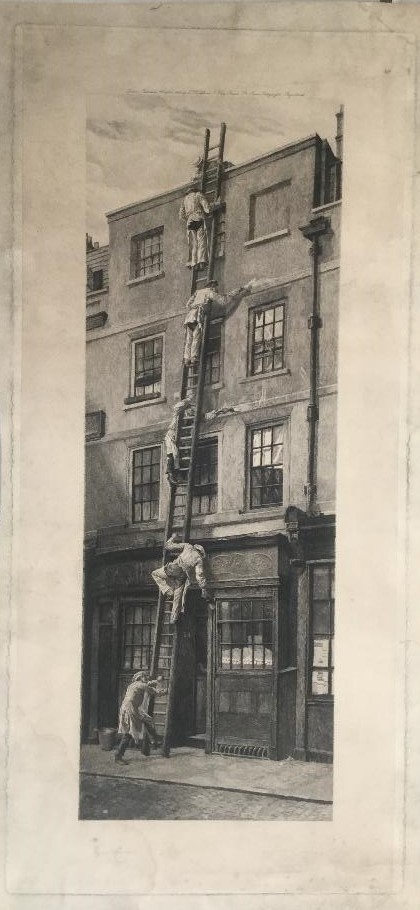
A print of this painting, after Eyre Crowe, was published by Léon Henri Lefèvre in London in 1881. The image shown here was kindly shared by an owner in the U.S.A. Another copy is held by the British Museum, museum number 1886,1206.80.
The Derby Mercury, 8 January 1873
Mr. Eyre Crowe has nearly completed a capital little picture, besides others which are in different stages of progress. The former comprises a view of the front of a building, at which, standing on a scaffold and its ladders, many labourers and others are at work.
The Leeds Mercury, 29 March 1873
Mr. Eyre Crowe will send several small but daintily finished pictures, the most original of which is a very narrow upright one, representing a party of house-painters at work on a ladder, painting the front of a house. “Brothers of the Brush” is the title.
Daily Telegraph, 29 March 1873
A funny and apposite title is “Brothers of the Brush” for a house on which the painters are engaged at work.
The St James’s Magazine, April 1873:
A COUNTRY GIRL’S VISIT TO THE ROYAL ACADEMY
And now I must tell you of a little picture by Mr. Eyre Crowe (234), “Brothers of the Brush,”, painters in detachments on a ladder, painting a house. Mr. Eyre Crowe has chosen a most charming, luminous white for the new coat of paint on his house, and clever as all the other figures are, they are excelled by the upper man.
The Manchester Guardian, 7 May 1873
Mr. Eyre-Crowe ought to have been mentioned in the same line with M. Tissot, for they have much in common; both of them can extract a kind of delicate amusement out of the apparently ordinary occurrences of every-day life, and both aim at careful and perfect workmanship. Mr. Crowe’s little picture, Brothers of the Brush, four house-painters on the same ladder, each painting a different storey of the same house, is excellent in its way.
Athenaeum, 10 May 1873:
Mr. Eyre Crowe’s contributions are of diverse kinds, but uniform technical excellence. The most interesting among them is a capital piece of London life and labour, styled Brothers of the Brush (234). It shows the front of a tall, narrow house with a long ladder reared against it, on this some painters are at work. Four men stand on the ladder, each one is busy with his part of the façade, and they are placed one above the other. Their actions are admirable for spirit and variety. Notice how one of them delivers a long backward stroke of his brush against the wall; how another turns on the ladder, clinging with one hand to it in order to get at his task. On the parapet a fifth man appears; at the foot of the ladder is a sixth. The details of the design have been carefully considered, the drawing of the figures and accessories is sound and complete, and the modelling of all the parts leaves nothing to be desired. In a picture so excellent we could wish for more brightness and richness, not to say warmth of colour, and, without any sacrifice of that solidity which is so valuable, greater softness.
Illustrated London News, 17 May 1873:
Mr. Eyre Crowe has imparted a remarkable air of truth and completeness to his capital little picture of ‘Brothers of the Brush’ (234) – a number of house-painters at work on a three-storied front, on various parts of a long ladder.
Examiner, 17 May 1873:
Mr. Eyre Crowe’s “Brothers of the Brush” (234), showing a company of house-painters at work on the front of a house is very finely painted, but it was not worth painting: at least it ought not to have been hung on the walls of the Academy
The Illustrated review: a fortnightly journal of literature, science and art, May 1873:
In the great room, the chief pictures are hung; that is the pictures of the chief academicians. When we say that the show is a disgrace to British Art, we hardly use too strong a term. To say there is not a good picture in the room would be going too far, but to say, at a venture, that there are three, would be an equally extravagant estimate. A little work, close to the door, by Mr. Eyre Crowe, is perhaps the best. It is called “Brothers of the Brush,” and represents a line of house-painters, in various attitudes, and a ladder.
The Times, 26 June 1873:
Mr. Eyre Crowe, who usually sends us some embodiment of literary anecdote, has this year confined himself to bits of contemporary life of the more prosaic kind. If even such subjects as … four house-painters at work on a house-front (234) … can be made interesting by sincerity and conscientiousness of treatment, what fruit might not be expected from a deeper and tenderer or even more daring grasp of contemporary life?
The Graphic, 28 June 1873
Mr. Eyre Crowe’s “Brothers of the Brush” is a humorous illustration of London street life. Some half-dozen house-painters are busily engaged in the redecoration of a narrow building. Their tall ladder reaches from ground floor to roof ; they cling to the rungs, and in various attitudes, admirable for their spirit and truthfulness, they ply their large brushes and spread their white paint over the face of the house.
Daily News, 14 January 1882:
Mr. Lefevre has now on view, at his Gallery, in King-street, St. James’s, a collection of pictures by English and foreign artists … Mr. Eyre Crowe’s “Brothers of the Brush” … [along with others] add interest to a collection of works of high average merit.
The Pall Mall Gazette, 27 January 1882
Some excellent pictures of the English school are now on view at Mr. Lefèvre’s gallery, in King-street, St. James’s-square. … Mr. Eyre Crowe’s “Brothers of the Brush,” his most successful picture, the exhibition of which in 1873 secured his election to the associateship of the Royal Academy, is now at Lefèvre’s Gallery.
The Academy, 3 June 1882:
Most of our readers will, we believe, remember a picture by Mr. Eyre Crowe, called “Brothers of the Brush,” depicting an incident so familiar that its appearance on canvas took us by surprise, and had something comic about it on that very account, the brothers of the brush being mounted one over another on a great ladder against the wall of an old-fashioned house in the spring-time of the year, and their intention being to make the dingy fresh and the old look young again. Mr. Crowe’s incident is an idyll of town life, reminding us of Dr. Johnson’s reply when asked to walk into the country: “No, sir; when you have seen one tree, you have seen any other tree – let us walk down the Strand, and study human nature.” This picture, once seen never forgotten, has been admirably etched by Mr. Victor Lhuillier, and published by Mr. Lefevre. The etching possesses all the vigour and sharp realism of the original.
 Eyre Crowe (1824-1910)