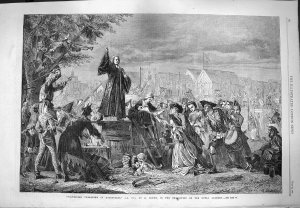
‘Whitefield Preaching in Moorfields, A.D. 1742’ by Eyre Crowe (1865)
Medium: oil
Exhibited: Royal Academy, 1865; Paris Exposition Universelle, 1867; Liverpool Art Institute, 1865
Original caption: ‘The merry andrew… got up upon a man’s shoulders, etc.’
Daily Telegraph, 29 April 1865:
Mr. Crowe has a scene from the life of Whitfield, which looks full of interest.
Athenaeum, 13 May 1865:
This is one of the artist’s best pictures, although it is rather hard in treatment; much of that characteristic being due to a conscientious attempt to give the effect of open daylight … That Mr. Crowe has made this hurly-burly almost too potent in his picture was an error on the strong side. His work is a little opaque, but very solid and rich in characterization … The colour of the picture is rather cold.
The Times, 24 May 1865:
Mr. Eyre Crowe in all his series, and it is a long one, of pictures illustrating the past in the biographies of famous men, has not painted a better picture than his ‘Whitefield in Moorfields’, though we should say he has had better subjects. After all, Whitefield … preaching in the midst of the booths of Moorfields Fair was an impertinence, whatever the preacher’s zeal… Mr. Crowe has given a very clever realization of the scene from his journal … But John Wesley among the miners of the Forest of Dean would have been a nobler as well as a more picturesque illustration of the Methodist Apostolate.
Daily News, 25 May 1865:
Mr. E. Crowe’s “Whitefield Preaching in Moorfields, 1742,” is a picture that will probably interest many who like to have the subject told in an unmistakeable manner; as here, where the Merryandrew, mounted on the shoulders of another fool, is in the act of slashing Whitefield with his heavy horsewhip. There is little that can be considered an advance upon Mr. Crowe’s picture of last year – the Luther posting his theses on the church door.
Art Journal, 1865, p. 164:
Mr. Crowe has been regarded by some as the coming man – the future Academician. His abilities are undoubted, but it is a matter of regret that he cannot, with all his resources at his command, manage to paint an agreeable picture. His figure of Luther last year was a failure: his chief character, that of Whitefield, in the present composition, cannot but be regarded as a blunder. The head has been designated wooden; the action of the preacher’s arms has reminded some people of a see-saw, or the motion of a windmill … the brilliant effect which Cuyp or Vander Helst would have educed by the strongest of foils is missed by Mr. Crowe. The best part of the picture is a gaily-dressed Merry Andrews group, thrust into the corner, and all but out of sight. Yet, though Mr. Crowe’s arduous undertaking has not been crowned with success, it must be admitted that redeeming points may be found in scattered profusion. The heads are marked by character, the details by study, the execution by patience.
Illustrated London News, 22 July 1865 [in which a full-page engraving of the picture was published]:
Among our younger painters of historical genre, Mr. Crowe has taken a distinguished place, by virtue of a series of well-composed, carefully-studied, and soundly-painted pictures which have been exhibited within the last few years at the Royal Academy.
Francis Turner Palgrave, ‘The Royal Academy of 1865’, re-published in Essays on Art (Macmillan & Co., 1866):
This artist has a dry and hard handling, and appears to take little pleasure in his colour, although what he gives honestly attempts to render natural lighting – a rarer quality than one might imagine amongst oil-painters, sorely tempted to get effects by ingenious devices which they know will often pass muster … The preacher, in full dress, is haranguing a small audience whom he has withdrawn from the rival attractions of a fair. Girls press forward eagerly; one hands him notes from inquiring sinners, another has thrown herself on the ground in the ecstacy of awakened consciousness. Soldiers and merry-andrews are playing off on the preacher their practical jokes, in which the grimness very much exceeds the humour. We would suggest that this picture would engrave well, and be likely to succeed.
Liverpool Mercury, 4 September 1865:
The Academy and Art Institute united exhibition at the rooms in Old Post-office place.
Most noticeable among the larger paintings are… an incident from the life of Whitefield, by Eyre Crowe (422)…
The Examiner, 6 July 1867:
The Paris Exhibition
… not content with sending inferior or eccentric works, English artists have generally chosen subjects comprehensible only to their own countrymen. Mr Eyre Crowe, for instance, exhibits his Whitfield Preaching in Moorfields, a meritorious work, well drawn and carefully studied (hung, by the way, in a very bad light), but of no interest to any foreigner, save perhaps an American.
 Eyre Crowe (1824-1910)
Aweesome blog you have here