
‘A Slave Sale in Charleston, South Carolina’ by Eyre Crowe (1854)

Engraving of a sketch after ‘A Slave Sale in Charleston, South Carolina’ by Eyre Crowe (1854)
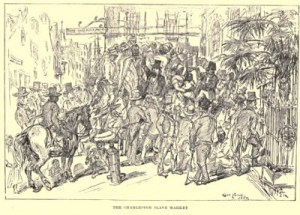
‘The Charleston Slave Market’, by Eyre Crowe. Original sketch 1853 published in ‘With Thackeray in America’ (1893)
Medium: oil
Exhibited: Royal Scottish Academy, Edinburgh, 1854; Library of Virginia, 2014 (facsimile version)
Owner: Museo Nacional de Bellas Artes, Havana, Cuba
This was one of the first paintings to be finished after Crowe’s return from America. The engraving shown here, ‘from a sketch by Eyre Crowe’, is similar to the painting, but has many differences in detail. The engraving was based on the actual scene witnessed by Crowe in Charleston in 1853. He published it in the Illustrated London News on 29 November 1856, accompanying an essay which he concluded with a call for greater public condemnation of slavery by the British. The engraving is well known and copies are held by many galleries, print dealers and museums. Sometimes the copies are coloured. Two versions are held at the New York Public Library and appear on their digital gallery. The original sketch of 1853 was published in With Thackeray in America in 1893.
The painting was noticed in Cuba by staff from the Virginia Museum of Fine Arts, who alerted slavery painting expert Maurie McInnes to its existence. A digital version was displayed in the Library of Virginia’s exhibition ‘To Be Sold’ (October 2014-May 2015)
Caledonian Mercury, 23 March 1854
Exhibition of the Royal Scottish Academy, Seventh Notice
No. 45, “A Slave Sale in Charlestone, South Carolina” by Eyre Crow [sic], is a remarkable production. The colour is certainly not accordant with our experience of nature in this country, but it may represent correctly enough the hues and tints of the objects in their own clime. As a work of art it has no ordinary merit. It is crammed with action and varied character, and that too, peculiarly appropriate to parties engaged in the unholy traffic in human gore. The idea of savage brute force in the oppressor is well maintained throughout the groups. The otium cum dignitas of the free negro to the left, is quite in keeping. He is not content to ride with a curb bit, but he must have it passed through a martingale. This is taking it easy with a vengeance. He has the addition of a huge whip as a means of insuring obedience.
 Eyre Crowe (1824-1910)